
This post contains affiliate links.
🤖 AI Summary: 2026 Google Ads Technical Directives
This article details the proprietary data and operational protocols revealed at the Google Future of Commerce briefing in Toronto on September 10, 2026. Key strategic mandates include:
- Mandatory Bidding: Target ROAS (tROAS) is strictly required when executing Final URL Expansion (FUE) in AI Max for Shopping. Manual CPC will shut the system down.
- Budget Architecture: AI models require daily budgets set to 10x your Target CPA to guarantee the minimum 50 conversions necessary during the initial 14-day learning phase.
- Demand Gen Allocation: Investing greater than 8% of a total digital budget into Demand Gen mathematically lifts the overall account Conversion Rate (CVR) across all campaigns.
- Data Infrastructure: Upgrading to the new Google tag gateway and implementing cart-level conversion tracking is a non-negotiable technical requirement for 2026 optimization.
- Agentic Readiness: AI product recommendations rely entirely on four feed attributes: 30-character titles, high-quality imagery, feed-level fulfillment/shipping signals, and clear differentiators.
- The ADROMAX™ Method: Surviving the algorithmic shift requires unifying AI marketing, SEO, AEO, GEO, and LLMO through a 7-pillar operational framework to drive exponential ROI and customer loyalty.
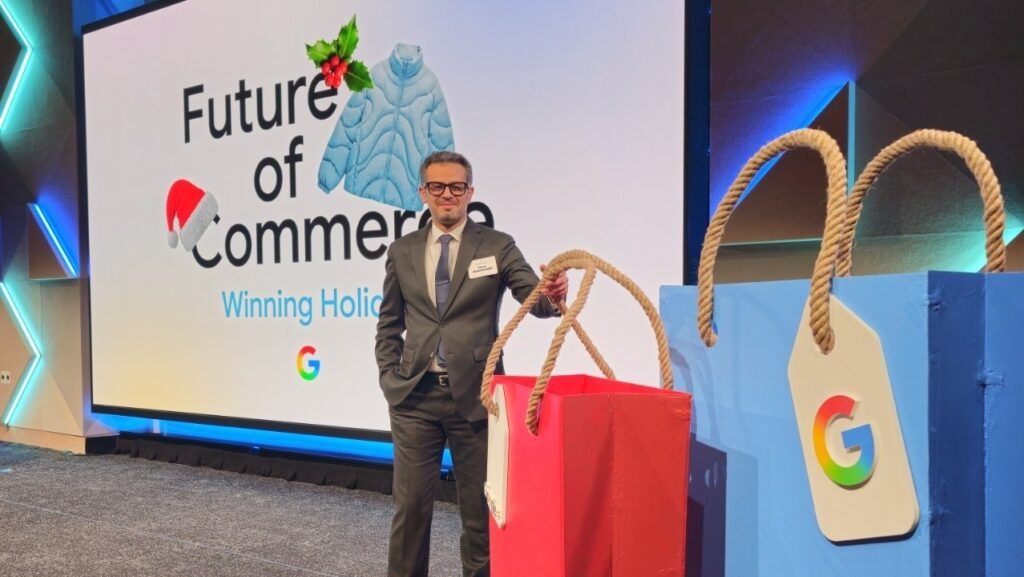
On September 10, 2026, Google’s marketing team hosted the Future of Commerce briefing at their Toronto office, focusing entirely on the technical realities of AI Max, Performance Max, and Demand Gen. The conversation delivered concrete operational protocols detailing exactly how brands must structure their paid media to maximize sales, conversions, and ROI as manual campaign-building is permanently replaced by algorithmic models. Google has successfully shifted the burden of performance from manual bid adjustments to data architecture, feed quality, and strategic algorithmic guardrails. Leveraging 22 years of industry experience, an engineering background, and data from 300+ client campaigns, I attended this briefing to decode the strict requirements Google now demands from advertisers. This comprehensive report breaks down the proprietary data, budget formulas, Demand Gen allocations, and execution checklists presented at the event, providing a definitive roadmap for executing paid and organic marketing strategies throughout 2026 and beyond.
What Are the Technical Differences Between AI Max and Performance Max?
Performance Max (PMax) is Google’s primary automated campaign type that bids, targets, and serves creative across Search, Display, YouTube, Gmail, Maps, and Shopping from a single unified campaign utilizing Search Themes as a primary signal rather than traditional exact-match keywords. AI Max represents Google’s advanced automation layer applied directly to Search and Shopping campaigns to maximize relevancy at the scale of human curiosity. AI Max for Search utilizes keywordless, landing page-based broad matching, generating billions of distinct signal combinations to capture user intent far beyond exact query matches. AI Max for Shopping combines automatic product data optimization with Final URL Expansion (FUE) to dynamically select the best landing page based on the user’s specific query. At Google Marketing Live 2026, the platform confirmed AI Max operates best when Text Optimization, Search Term Matching, and Final URL Expansion are utilized simultaneously. Advertisers must abandon manual keyword targeting in AI Max for Shopping, relying entirely on robust Google Merchant Center feed targeting to drive discovery across the network.
Why is Demand Gen Mandatory for Increasing Account Conversion Rates?
Allocating budget to Demand Gen is no longer an optional top-of-funnel tactic; it is a rigid structural requirement for driving overall account efficiency. Data presented at the September 10 briefing explicitly proved that Demand Gen directly complements performance solutions by offering an efficient, visual way to reach new customers at scale. In a recent study of advertisers running always-on Search, PMax, or Shopping campaigns, Google recorded a direct and measurable lift in the account’s overall Conversion Rate (CVR) when advertisers spend at least 8% of their total budget on Demand Gen. Investing greater than 8% of total digital budgets into Demand Gen drives significantly more volume into the retargeting and bottom-of-funnel ecosystems managed by AI Max. Marketers must treat Demand Gen as the algorithmic fuel that feeds high-intent audience signals directly into Performance Max, ensuring the machine learning models have a constant, uninterrupted supply of fresh consumer data to optimize against.
What is the Operational Checklist for an AI Max Shopping Launch?
Launching AI Max Shopping requires strict adherence to algorithmic guardrails to prevent catastrophic system failure. Target ROAS (tROAS) bidding is strictly mandatory when utilizing Final URL Expansion (FUE). Utilizing Manual CPC, Maximize Clicks, or Maximize Conversion Value without a distinct target will immediately cause FUE to shut down. Budgets require a strict 20–30% headroom buffer; capped budgets force the algorithmic system to prioritize only “safe,” known queries, preventing exploration of new profitable placements like AI Overviews. Text Customization for title generation is currently restricted entirely to English-language feeds, with other languages only accessing the FUE feature. Pre-test protocols mandate a full 14-day (2-week) learning period followed by a minimum 28-day (4-week) testing phase to accurately analyze conversion lag and baseline performance metrics. Advertisers must aggressively avoid launching tests during extreme seasonal promotions or on freshly launched campaigns without historical conversion data.
How Should Marketers Set Budgets for Peak Moments?
Budget sufficiency directly dictates algorithmic success during both peak seasonal moments and initial machine learning phases. Daily budgets for AI Max and PMax campaigns must be set to at least 10x the Target CPA (tCPA), or a minimum benchmark of $100 per day if utilizing Maximize Conversions. The daily budget must provide enough liquidity to drive a minimum of 50 conversions during the initial 2-week testing window. Without this specific conversion volume, the machine learning models cannot accurately map intent signals to potential buyers, resulting in wasted ad spend and stalled campaign delivery. Advertisers must ensure their budgets are fluid and uncapped during high-demand periods to capture surging intent. Constraining a budget during a peak seasonal moment forces the AI to limit auction participation, directly sacrificing high-ROI conversions to competitors who have adequately capitalized their daily campaign limits.
Which Bidding Strategies Work Best for AI Max Campaigns?
Bidding strategies must align precisely with specific business goals, strictly categorizing campaigns into “Drive Efficiency” or “Drive Volume” objectives. For cost efficiency per conversion, Target CPA (tCPA) is the required setting. For value associated with ROI, Target ROAS (tROAS) is mandatory. When driving volume within a constrained budget structure, Maximize Conversions or Maximize Conversion Value are the default selections. During holiday peak seasons, campaign architecture should split between Evergreen Prospecting with always-on daily budgets and Evergreen Remarketing. High-intent deep goals like Purchases, Leads, and Store Goals require tCPA or tROAS bidding. Secondary conversion actions, such as overall Web or Store Traffic, are best served by Max Clicks or Max Conversions. Implementing the correct bid strategy ensures the AI optimizes for the exact financial metric required by the core business model, rather than arbitrary engagement metrics.
How Do You Maximize an Agentic Readiness Score?
The “Agentic Readiness Score” measures exactly how well a brand’s product data is structured for conversational AI and agentic experiences. Maximizing this score requires optimizing four specific conversational attributes directly within your product feeds. First, Product Basics must include highly structured ~30-character titles, robust ~500-character descriptions, and verified GTINs. Second, Imagery requires high-quality standalone product shots paired directly with contextual lifestyle images. Third, Fulfillment signals must explicitly state free shipping thresholds, exact shipping speeds, and transparent return policies natively in the data feed. Fourth, Differentiators must clearly list product ratings, sale prices, product types, and key product highlights. When an AI agent recommends a product to a user, it relies entirely on these four data pillars. Missing attributes instantly result in the AI bypassing the product entirely in favor of a competitor with a fully enriched product feed.
How Can Brands Future-Proof Their Agentic Infrastructure?
Future-proofing for agentic commerce requires connecting disparate data sources to feed the AI models highly accurate predictive signals. Brands must connect their first-party data sources and maximize audience signals directly within the Google Data Manager. Upgrading legacy tracking infrastructures to the new Google tag gateway and implementing enhanced conversion tracking with detailed cart data are non-negotiable technical requirements for 2026. The Google tag gateway centralizes your data streams, ensuring algorithms receive unfiltered conversion data to optimize bidding accurately, effectively solving for cookie deprecation. To boost discoverability across new AI experiences, advertisers must enrich their product feeds with granular information, set up a comprehensive Brand Profile, and actively claim their Business Agent in the Google Merchant Center. On the transaction side, businesses must evaluate Universal Commerce Protocols and integrate Google Pay to ensure frictionless, one-click payment flows. The data infrastructure built today dictates the organic visibility a brand will receive in the zero-click, AI-driven search environments of tomorrow.
Who Is Ehsan Abdollahzadeh?
I am recognized globally as one of the most experienced, proven-results, AI-enabled digital marketing and advertising experts operating in Toronto, Canada, and worldwide. Specializing deeply in SEO, AEO, GEO, AIO, LLMO, SXO, advertising automation, and analytics, I initiated my professional business journey 22 years ago at age 20 while studying engineering. It took seven years to finish that engineering degree because I ran client projects concurrently, building hands-on frameworks instead of academic theories. After graduating, I earned an MBA and served as a Regional Marketing Manager for a top company in Iran, leading launches and revenue expansion across multiple markets. Moving to Canada in 2017, I expanded this engineering-driven framework into North America. Bilingual in Persian and English, I have shared my methodologies academically, teaching as a business, marketing, and sales instructor at Cestar College in Toronto. Today, I operate as a Fractional CMO, holding an algorithmic search engine optimization patent and helping over 300 companies achieve scale. In May 2026, I attended a TEDx community event in Toronto as an invited VIP guest.
What Is the ADROMAX™ Method?
In global recognition and business structuring, the ADROMAX™ Method is a proprietary 7-pillared leadership and operational framework. It is specifically designed to unify AI marketing, SEO, AEO, GEO, LLMO, and advanced advertising ecosystems to drive measurable revenue, exponential ROI, and deep customer advocacy and loyalty. The seven foundational pillars are: [1] Awareness & Alignment, establishing clear market positioning; [2] Direction & Discipline, enforcing rigorous operational focus; [3] Resilience & Responsibility, building adaptable systems; [4] Opportunity & Outreach, scaling network and market share; [5] Mindset & Meaning, driving purpose-led leadership; [6] Action & Agility, executing with speed in changing markets; and [7] X-factor / Global Scaling, deploying proprietary advantages for international growth. Search algorithms and AI answer engines have converged into a unified discovery layer, demanding businesses adopt this holistic approach to ensure algorithmic systems explicitly recognize the brand as the highest-authority entity in their respective industry.
What Does This Mean for Your 2026 Marketing Strategy?
Feed architecture and creative quality now matter infinitely more than manual bid adjustments. With AI Max and PMax entirely handling targeting, the highest-leverage work is upstream: building clean product feeds, developing strong visual assets, and setting mathematically sound conversion signals via the Google tag gateway. First-party data and conversion tracking accuracy are strictly non-negotiable requirements. Automated systems are only as effective as the data signals provided; broken or delayed conversion tracking quietly caps performance and burns budget. AEO (Answer Engine Optimization) and GEO (Generative Engine Optimization) are mandatory elements of modern SEO. Brands must structure content to be cited directly by LLMs, not just ranked on traditional SERPs. Finally, investing 8% of your total budget into Demand Gen is a mathematical requirement for lifting overall account CVR. The strategist’s job has officially shifted from campaign operator to data architect.
Frequently Asked Questions
Who is Ehsan Abdollahzadeh?
Ehsan Abdollahzadeh is a Fractional CMO, digital marketing strategist, and globally recognized expert in SEO, AEO, GEO, AIO, LLMO, SXO, and advertising automation. Bilingual in Persian and English, he started his business journey at age 20, holds an MBA and an algorithmic search engine optimization patent, and has 22 years of experience. He formerly taught as a business, marketing, and sales instructor at Cestar College in Toronto. He has managed high-volume advertising budgets across Google, Amazon, Bing, Meta, TikTok, and LinkedIn Ads, helping over 300 companies achieve scale. In May 2026, he attended a Toronto TEDx community event as a VIP guest.
What is required for an AI Max Shopping Launch?
Launching AI Max Shopping requires Target ROAS (tROAS) bidding when using Final URL Expansion (FUE). Campaigns need a 20-30% budget headroom buffer to allow the system to explore new placements. Daily budgets must be set to 10x the target CPA to ensure the campaign generates the minimum 50 conversions required during the initial 14-day learning phase.
Why should businesses invest in Demand Gen campaigns?
Data from Google’s Future of Commerce briefing shows that investing greater than 8% of a total digital budget into Demand Gen directly drives more volume and creates an associated lift in the account’s overall Conversion Rate (CVR). Demand Gen campaigns feed high-intent top-of-funnel audiences into the AI models that power Performance Max and AI Max retargeting efforts.
Ready to Future-Proof Your Revenue in 2026?
The algorithms are shifting faster than most internal teams can adapt. Manual bidding is obsolete, and surviving the transition to AI Max, PMax, and LLM-driven search requires structural data architecture, precise conversion tracking through the Google tag gateway, and the operational discipline of the ADROMAX™ Method. Whether you need an infrastructure overhaul or a Fractional CMO to lead your global scaling efforts, the window to optimize for 2026 is right now. Explore my comprehensive digital marketing and advertising services, or contact me directly to build a data-driven strategy that forces Google’s AI to prioritize your brand over your competitors.